Leverkusen, Germany
April 24, 2026
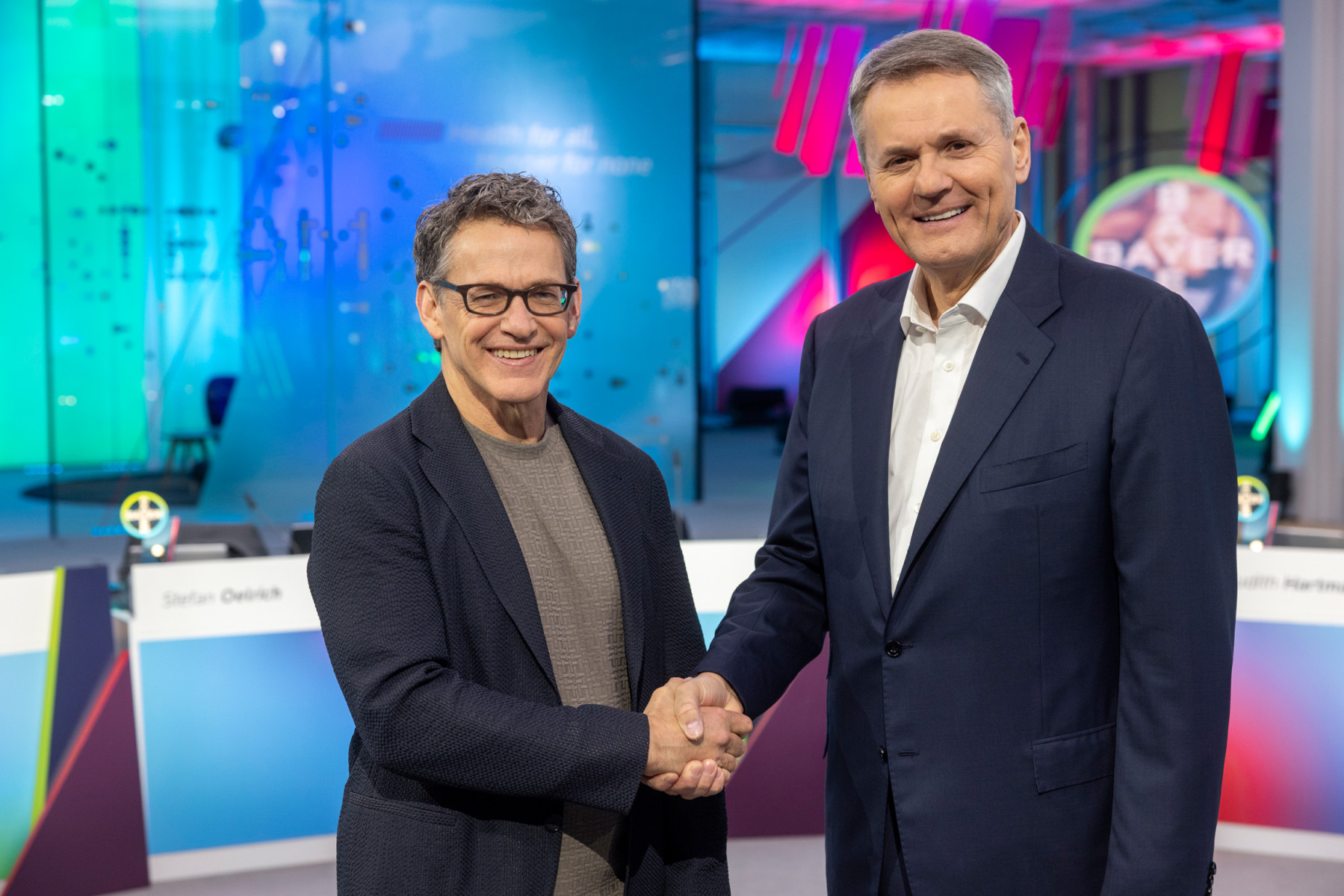 Bayer CEO Bill Anderson (left) and Supervisory Board Chairman Prof. Dr. Norbert Winkeljohann
The Bayer Group continues to make headway as it looks to advance its turnaround. While speaking at the company’s virtual Annual Stockholders’ Meeting on Friday, CEO Bill Anderson said: “We see great progress. But the work isn’t complete. Yet.” Around two years after setting out an agenda to enhance performance and regain strategic flexibility, he explained that “no corner of the company is the same as it was. Bayer is leaner and faster. The Pharmaceuticals portfolio and pipeline are more promising than perhaps ever before. Crop Science is executing its performance improvement plan. The debt burden is lower. We’ve advanced a multi-pronged strategy to address the litigation uncertainty. Our businesses delivered the 2025 numbers in virtually every metric.” Anderson also highlighted the performance of Bayer’s employees, as did Chairman of the Supervisory Board Prof. Dr. Norbert Winkeljohann, who expressed his appreciation for their efforts. In addition, Winkeljohann explained that “we have embarked on a clear path to ensure Bayer is best-placed to thrive in the competitive environment – and are committed to making further headway in the year ahead.”
Anderson addressed each of the company’s five strategic priorities.
Regarding the pipeline and launches in the prescription medicines business (Pharmaceuticals), Bayer has made major progress over the past two years and will continue to advance its efforts in this area. Nubeqa™, a cancer drug, and Kerendia™, a medication for the treatment of heart failure and chronic kidney disease, grew a combined 68 percent in 2025. In view of the recent label extension for Kerendia™, Bayer sees blockbuster potential in both indications. Meanwhile, the heart drug Beyonttra™ has been outpacing sales expectations since its launch. Furthermore, the launch of Lynkuet™, the company’s non-hormonal treatment for menopause symptoms, is now being extended to the European Union after starting in the United States. In addition, the study results recently released for asundexian, Bayer’s investigational medicine in secondary stroke prevention, underline the drug’s major potential.
In the agriculture business (Crop Science), Bayer has launched an extensive performance improvement program, with the division having taken steps to rationalize its portfolio and footprint. In the crop protection business, for instance, it is reshaping its portfolio around higher margin, more innovative products. After launching the insecticide Plenexos™ in Colombia in late 2025, the company expects to achieve registration in Brazil later this year. The product only needs to be applied in small quantities to effectively protect harvests against pests. Looking ahead, the division is planning to deliver major innovations that will really take off in 2027 and beyond. For 2026, meanwhile, the division’s performance improvement work remains a top priority, as it takes steps to improve cash generation and strengthen the operational foundation of its business.
Progress on the US litigation front
The company continues to execute its multi-pronged strategy to contain US litigation and has made important strides in this area. In February, Monsanto announced a class settlement, which received preliminary approval in early March. In addition, the US Supreme Court will hear oral arguments in the Durnell case on Monday next week. “This is a big milestone for American farmers, and a lot is riding on it,” Anderson said. He also noted how, in early April, lawmakers in Kentucky had voted to enact legislation protecting farmers’ access to scientifically regulated crop protection products. Commenting on the company's containment efforts overall, Anderson explained that “this remains an active situation, with important milestones and decisions in the weeks ahead. We continue to take it one day at a time and remain prepared for all scenarios.”
Cash generation and deleveraging remains a top priority for Bayer. As previously communicated, the company is therefore proposing to only pay out the legal minimum in dividends for 2025, amounting to 0.11 euros per share. “This is not an easy step, but it remains the right one for the company’s financial future,” Anderson said, adding: “As we consider our dividend policy going forward, we will carefully look at the company’s capital allocation strategy, given our cash and debt position.”
On the organizational front, Bayer has reoriented the focus of the firm from “administering” to “doing” while leveraging its new operating model. “Bayer is moving faster, more flexibly, at less cost,” Anderson said, with focus now turned to scaling key mechanics and practices of the new system. “We feel this set-up positions us well for the coming artificial intelligence revolution,” he explained, while also noting that many companies leading the AI charge are moving in a similar direction: flatter organizations, larger teams, more nimble rhythms, and faster, more fluid sharing of information. In addition, the company continues to make significant investments in its IT infrastructure, in streamlining its systems and simplifying the way it sorts data so that employees and customers alike can benefit from the full intelligence of the enterprise.
In fiscal 2025, Bayer achieved its targets for the year, after having upgraded its currency-adjusted Group outlook for sales and earnings in late July. Sales came in at 45.6 billion euros, while core earnings per share amounted to 4.91 euros. In addition, Bayer generated 2.1 billion euros of free cash flow and reduced its net financial debt to 29.8 billion euros. “In terms of our outlook, we anticipate a solid year across our businesses, which are off to a good start,” Anderson noted.
Changes on the Board of Management and Supervisory Board
Appearing at her first Bayer Annual Stockholders’ Meeting, Dr. Judith Hartmann introduced herself to shareholders. After having joined the Board of Management on March 1, she will succeed Wolfgang Nickl as CFO when he steps down on May 31, 2026. In addition, the Supervisory Board extended the service contract of CEO Bill Anderson to March 31, 2029, and the service contract of Stefan Oelrich, head of the Pharmaceuticals Division, to October 31, 2029. In March of this year, the Supervisory Board also extended the service contract of Heike Prinz, Labor Director and Board of Management member responsible for Human Resources, to August 31, 2028.
One of the items on the agenda for this year’s Annual Stockholders’ Meeting concerned the election of two new stockholder representatives to the Supervisory Board. As previously communicated, the candidates proposed for the roles are Marcel Smits and Alfred Stern. In total, three Supervisory Board members step down at the end of the Annual Stockholders’ Meeting. In his capacity as Chairman of the Supervisory Board, Winkeljohann thanked Colleen Goggins, Dr. Paul Achleitner and employee representative Frank Löllgen for their many years of dedication and hard work as members of the Supervisory Board and its committees. Bayer has submitted the relevant application for a court-appointed successor to Löllgen.




 Topics
 Species