Ithaca, New York, USA
October 29, 2025
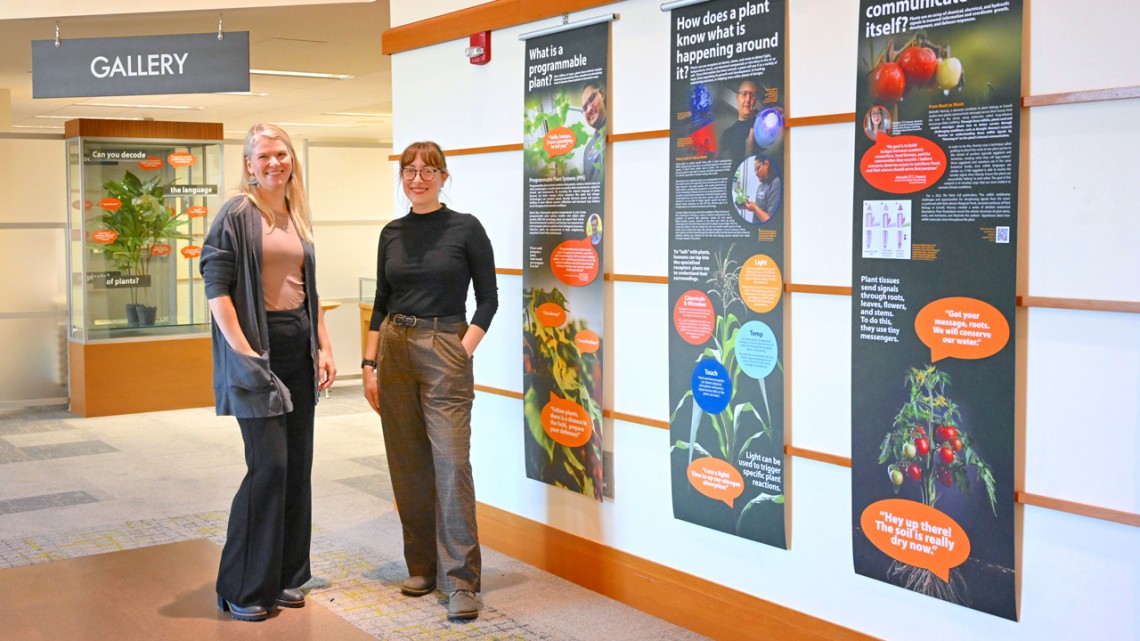 Cornell University Library’s Jenny Leijonhufvud (left), and CROPPS’s Anya Gruber at the “Hello, Human!” exhibit they co-curated at Mann Library. - Credit: Jose Beduya/Cornell University Library
Plants that send text messages when their leaves get injured; crops that change color to signal a lack of water or nutrients; computerized models that tell farmers how plants will behave under different conditions – these and other examples of innovations in plant-human communication are part of a new exhibit, opening Nov. 6 at Mann Library gallery.
The Cornell University Library exhibit, “Hello, Human! The Emerging Science of Plant Communication and Smart Agriculture,” showcases projects by Center for Research on Programmable Plant Systems (CROPPS) scientists at Cornell and other partner institutions, including Boyce Thompson Institute, Colorado State University, Tuskegee University, University of Arizona, and University of Illinois, Urbana-Champaign.
“We’ve highlighted projects that decode plant languages, the different signals that plants use to communicate that they are under stress, and how humans are learning how to understand that language,” said Anya Gruber, CROPPS public engagement specialist and exhibit co-curator.
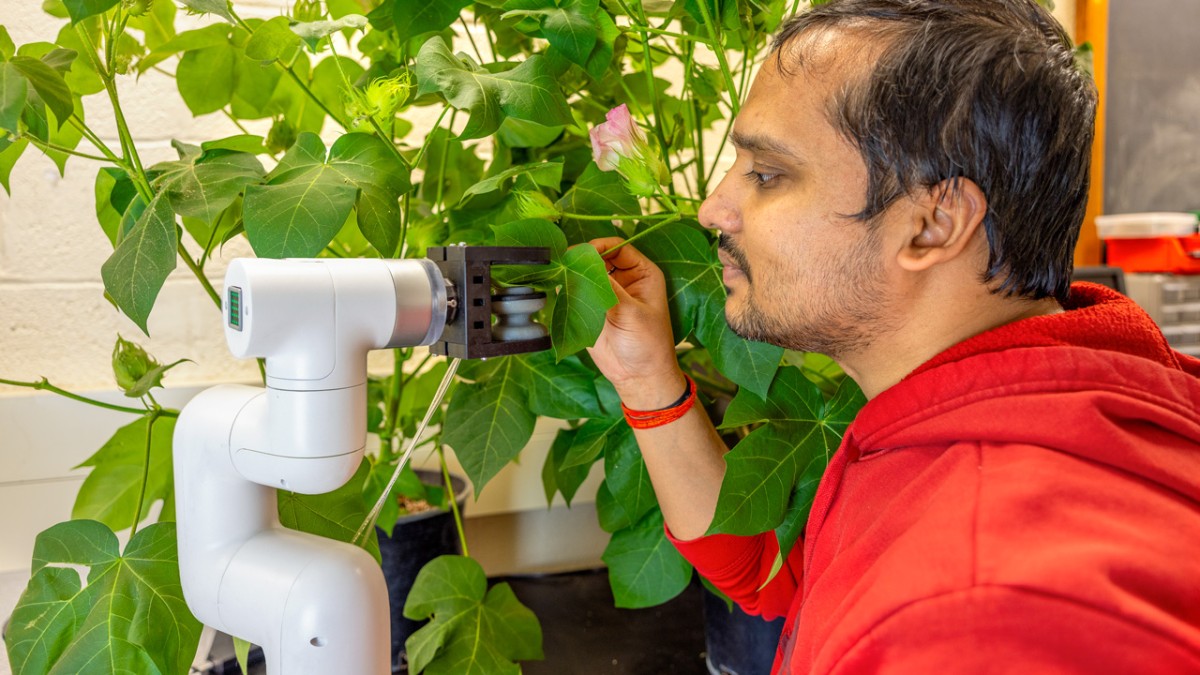
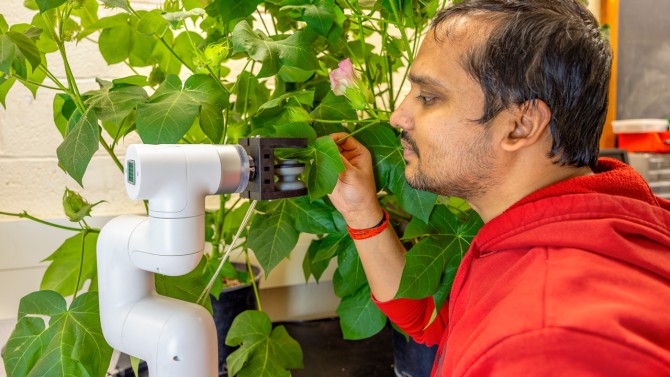 Former postdoctoral researcher Anand Mishra with a robotic gripper that gently injects living plants with sensors. - Credit: Provided
On opening night, 4-5:30 p.m., Cornell faculty members and student groups will conduct demonstrations of their work, including a project from a team of engineering, computer science and plant biology students called CROPPS-in-a-Box.
“It has a device on the inside of the box that cuts the leaf of the plant a little bit, and that injury to the plant leaf releases a chemical signal that is detected by a sensor inside the box, and a computer triggers a text message to your phone saying that it’s been hurt,” Gruber said. “It’s a really interesting and very immediate example of communicating directly with the plant.”
Doctoral students will also talk about their invention of RedAlert Living Sensors, genetically engineered tomato plants that turn red, from its roots to its leaves, to indicate a lack of nitrogen in the soil. The project – which earned a Runner Up Award from the National Collegiate Inventors Hall of Fame – is an example of “sentinel” or “reporter” plants that are planted next to crops to alert farmers, Gruber said.
The interactive demonstrations complement the exhibition panels, which answer questions that range from “What is a programmable plant?” to “How can biotechnologies be socially and ethically responsible?”
“A lot of the science that goes on here is very complex, and a lay person will probably walk into this exhibit with a lot of questions,” said Jenny Leijonhufvud, exhibit curator and outreach space coordinator at Mann Library, who co-curated and designed the exhibit. “And so we structured the exhibit around these kinds of questions.”
“Hello, Human!” runs through March 2026. It is the first in a series of exhibits titled “From the Brink: Contributions to a Sustainable Future from Across Cornell,” hosted by different libraries across Cornell University Library in collaboration with other departments and groups on campus. The series will showcase collections, research and partnerships that address issues affecting the environment.
“We hope this series as a whole helps illuminate threats of environmental and cultural loss and, most importantly, that it spurs conversations about ways in which each of us can support the resilience of our planet and communities,” Leijonhufvud said.


 Topics
 Species