Germany
May 5, 2025
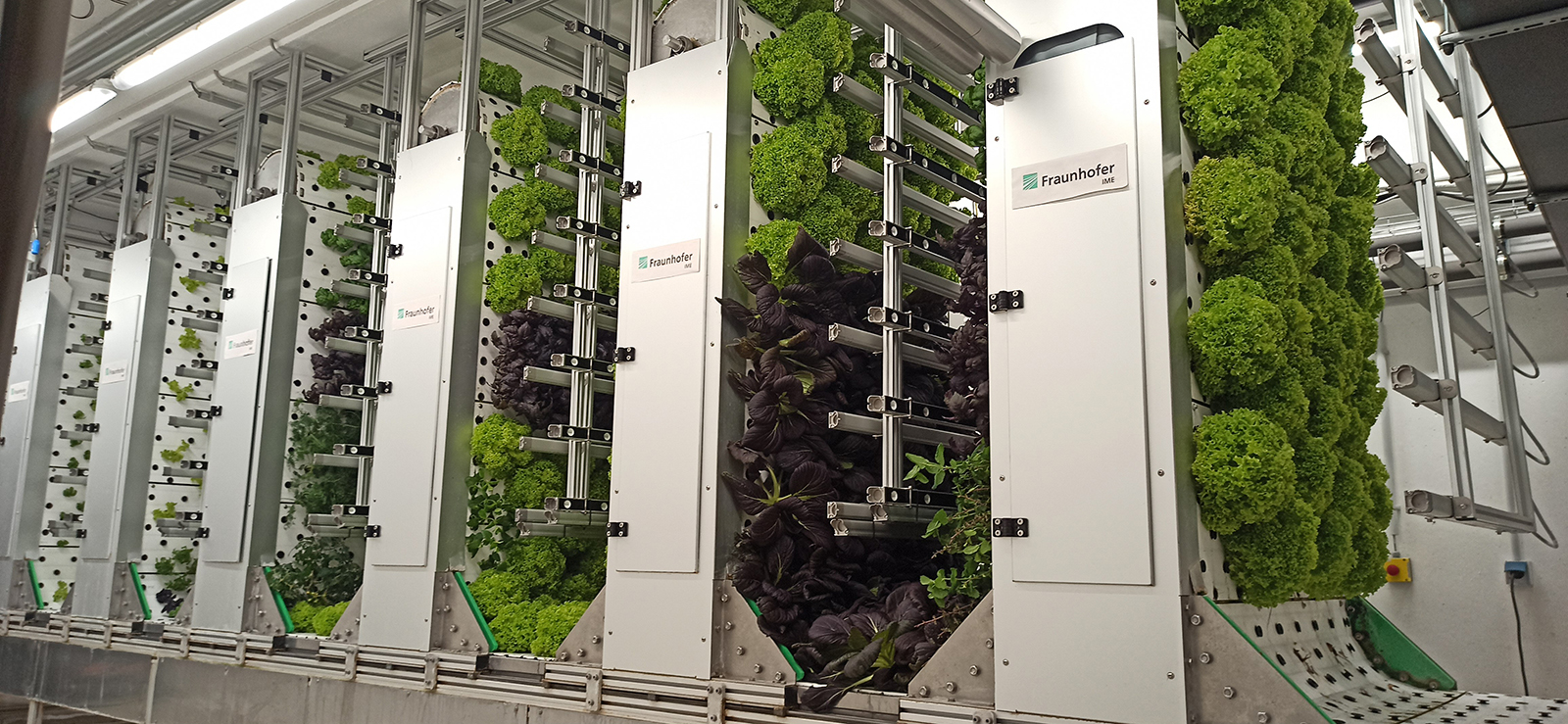
The OrbiPlant® technology, which is based on the design of a conveyor belt, enables space-saving plant cultivation. © Fraunhofer IME
To produce protein-rich foods sustainably, novel protein sources offer an alternative to meat, dairy and other animal products. In the FutureProteins flagship project, six Fraunhofer institutes have developed closed circulatory indoor cultivation systems for year-round production of proteins from alternative sources, independent of the climate and seasons. Then, as the next step, the researchers also combined the proteins and raw materials derived from plants, fungi, algae and insects with each other for the first time and processed them into prototypes for foods. The novel products and meat alternatives produced in this way are highly nutritionally valuable.
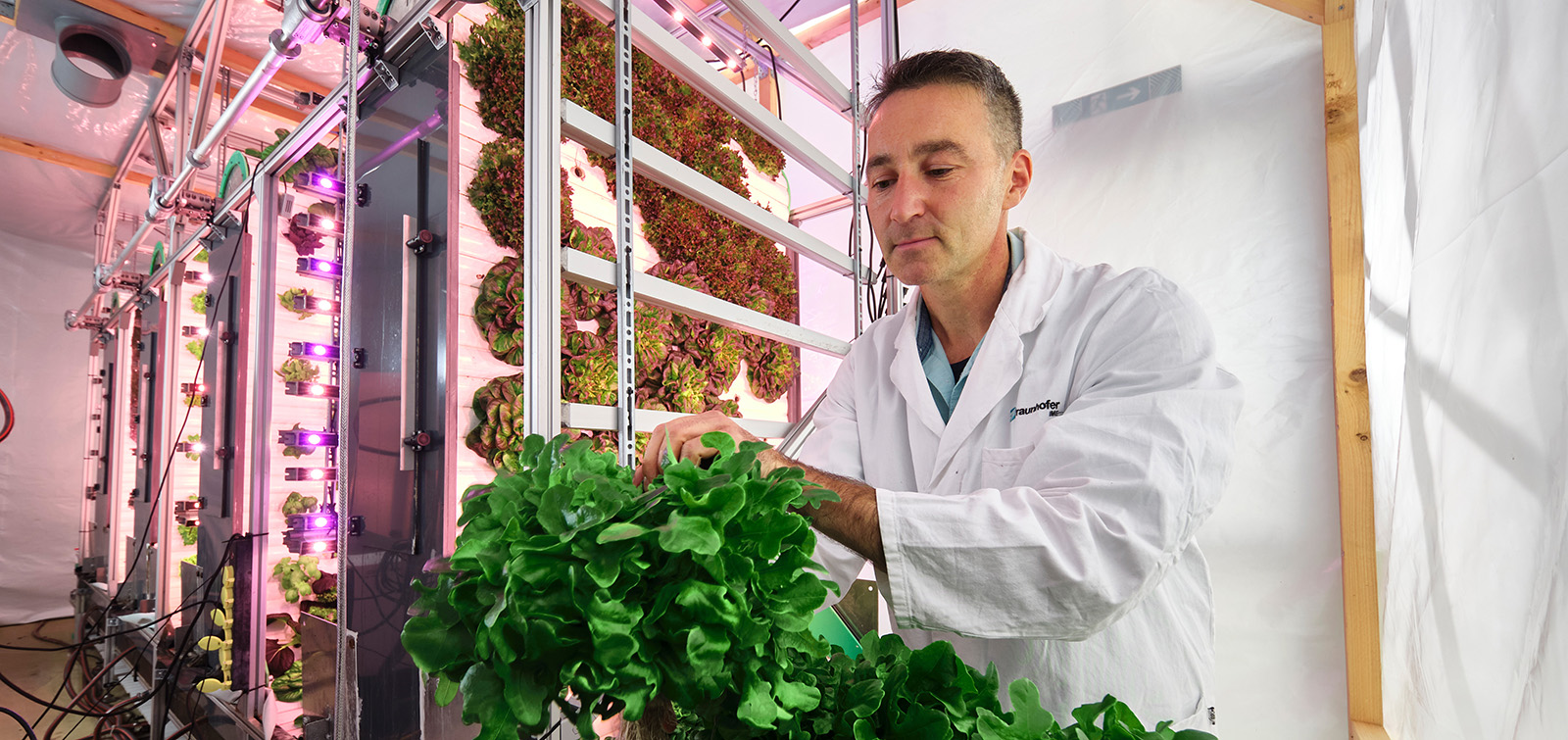
The highly versatile Orbi-Plant® vertical farming system can grow plants of different species continuously and completely independent of weather, time of day and season. © Fraunhofer IME
Across many areas of the world, growing environmental problems, extreme weather conditions and pollution of soil and water by pesticides and fertilizers are making it more difficult to supply the population with nutritionally valuable foods and proteins. This is making sustainable nutrition solutions even more important. One potential solution is alternative protein sources that can substitute for animal products such as meat, fish, eggs and milk. Researchers have teamed up in Fraunhofer’s FutureProteins flagship project to establish alternative proteins derived from plants, insects, fungi and algae. Six Fraunhofer institutes (see below) are pooling their expertise to sustainably exploit new protein sources for food production through specifically developed indoor cultivation systems that can be used all year, regardless of the climate, location and available space. One special aspect is that the byproducts generated in the process are largely used to produce other protein sources, right in line with the principles of the circular economy. In addition to four indoor cultivation systems — vertical farming for plants, insect farming for insects, bioreactors for fungi and photobioreactors to cultivate algae — the researchers have developed a range of tasty items for the food industry. Their creations range from burgers to gluten-free breads and desserts.
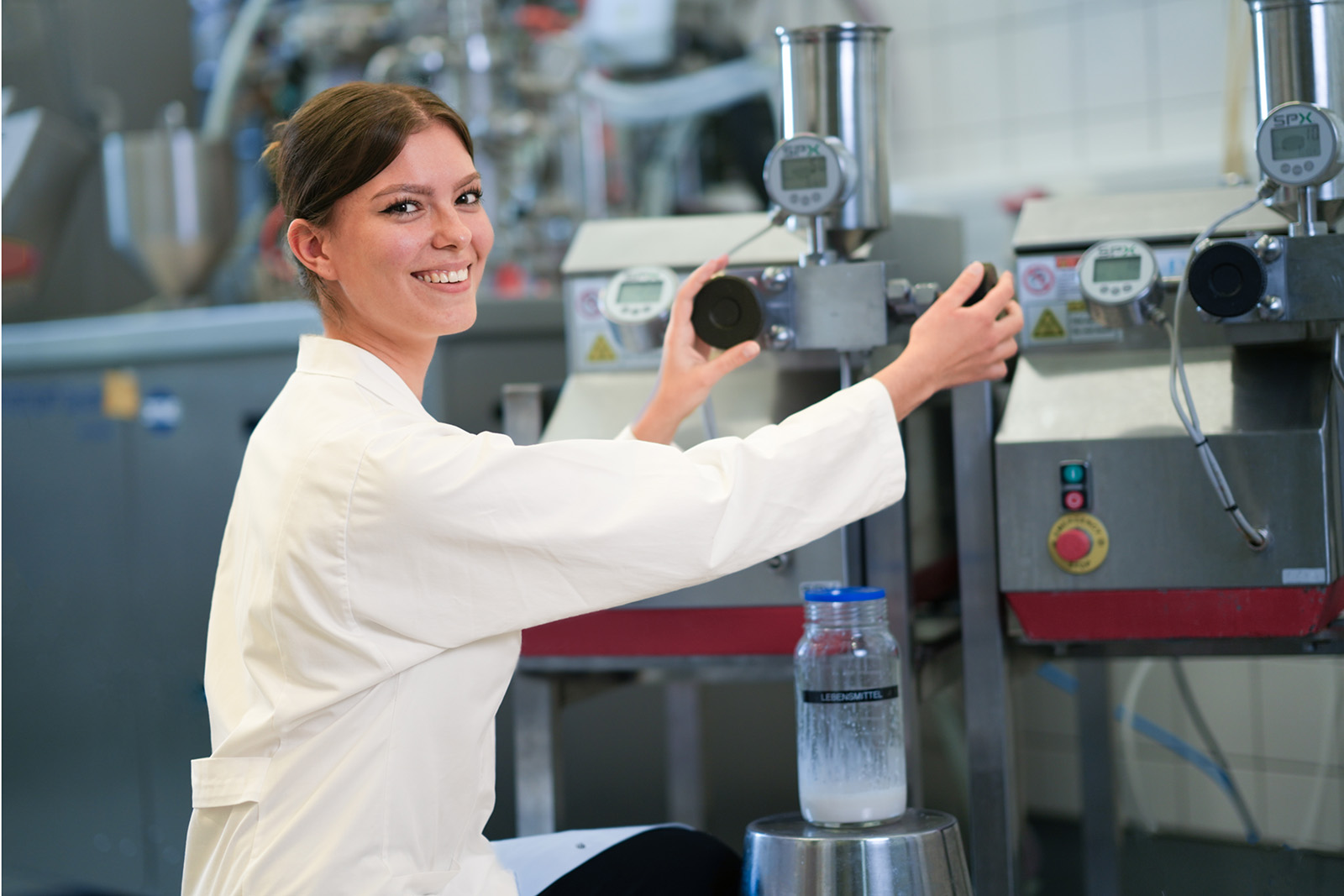
Fraunhofer IVV expert during the development and testing of milk alternatives for one of the institute’s industry partners. © Fraunhofer IVV
Potato residue for fungal fermentation and insect feed
“With an eye to climate change, we felt it was important to make sure all the newly developed indoor systems could be used regardless of the location, available space and season, thereby ensuring year-round local and sustainable cultivation of the various raw materials,” says Dr. Marc Stift, a research scientist and project coordinator at the Fraunhofer Institute for Molecular Biology and Applied Ecology IME in Aachen. The four different systems also interlock in the sense that byproducts from the various processing stages can be used to cultivate other protein systems. “As an example, potatoes are finely ground after they are harvested, producing starch and proteins that leave behind a watery medium and potato residue known as pomace. This potato pomace contains fiber, which was identified in the project as an outstanding fermentation substrate for fungi,” explains Dr. Stephanie Mittermaier, a project coordinator and research scientist at the Fraunhofer Institute for Process Engineering and Packaging IVV in Freising. Similarly, nitrogen-rich byproducts of insect production can be used as plant fertilizer.
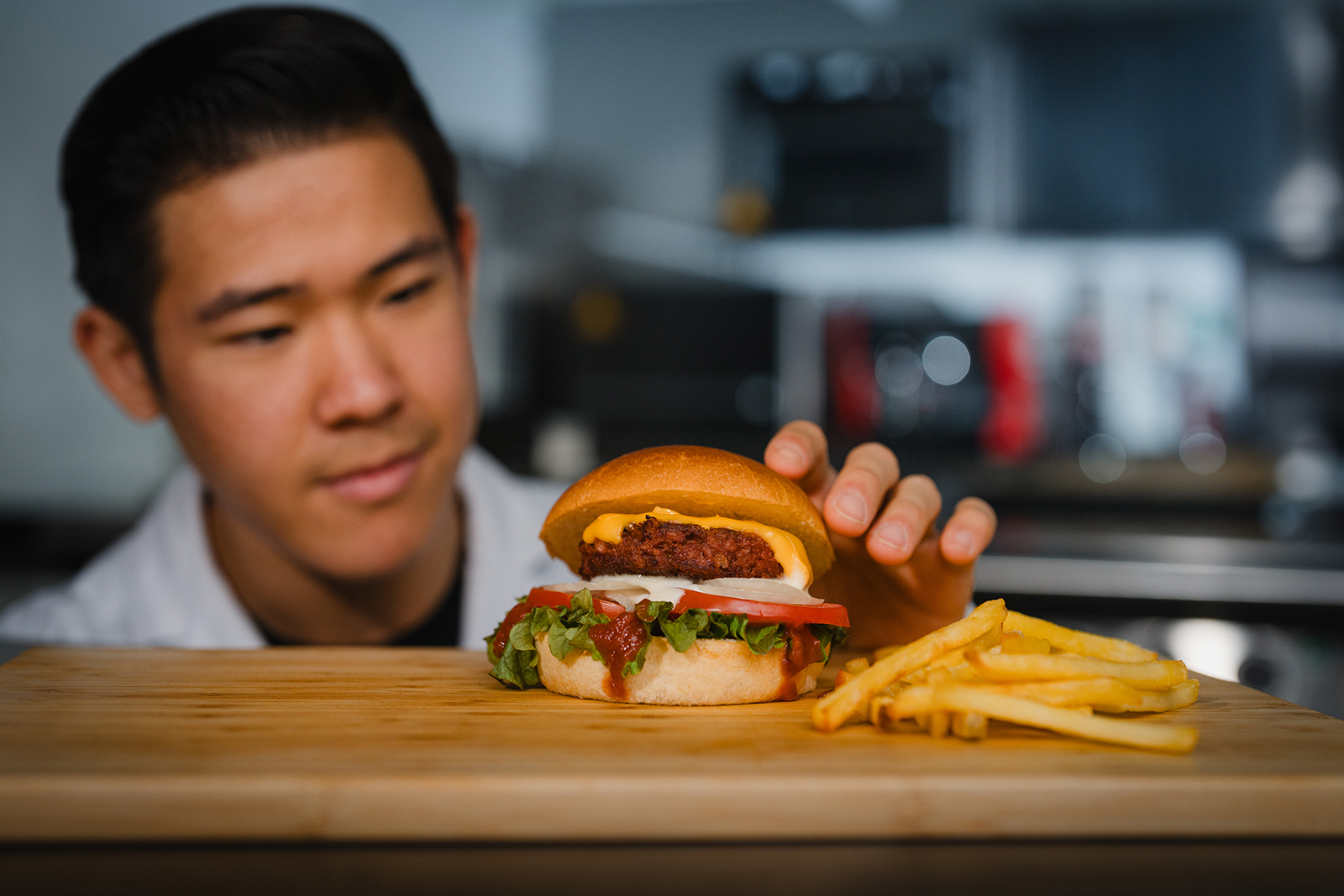
© Fraunhofer IVV
The vegan meat alternatives developed at Fraunhofer IVV combine different protein sources such as peas and mushrooms, resulting in particularly juicy burger patties with an improved nutritional profile.
Innovative vertical farming system: peas growing in waves
With the OrbiPlant® technology developed at Fraunhofer IME, the researchers have become the first to grow peas efficiently indoors. The system, which is designed like a conveyor belt, eliminates the need for pesticides while also saving space and cutting water use by 95 percent and fertilizer by 50 percent. It moves in a wave-like motion so that the plants inserted into the conveyor belt grow both upward and downward, along with the system’s movements. This allows for space-saving cultivation. One advantage of this design is that the lighting system used illuminates the valleys that form as the undulating conveyor belt moves downward so that the air can escape upward, preventing the heat buildup commonly found in conventional stacked designs. The system features built-in natural air conditioning, which significantly reduces the costs of climate control. The plants hover in the air as the conveyor belt moves up and down and are irrigated aeroponically. “Aeroponics is a special method of growing plants without a substrate. The roots hang down on the inside of the belt, where they are sprayed with a solution of water and nutrients. Compared to hydroponics, in which the roots are suspended in the nutrient solution, aeroponic irrigation dramatically reduces the amount of water in the system,” Stift explains. The substrate-free method of cultivation also carries another advantage: Unlike when legumes that are grown outdoors, the plants are clean, and the entire biomass, including the leaves and roots, can be used directly to produce protein without prior washing.
Vegan meat substitute: burger patties made from a blend of peas and fungi
Developing high-quality, tasty foods from various protein sources is the task of the researchers at Fraunhofer IVV in Freising (near Munich). A food pilot plant featuring systems for producing meat and dairy alternatives and baked goods provides perfect conditions for developing market-ready foods. State-of-the-art analytical methods allow the researchers to evaluate individual raw materials with an eye to their composition, functional properties and sensory aspects such as taste and smell. “The goal is to combine the protein systems with the best properties in each case, optimize them in both sensory and functional terms and thereby create new products such as vegan meat alternatives,” Mittermaier says. The research work conducted in the FutureProteins project has produced a number of prototypes with high consumer acceptance: In addition to burger patties and vegan meatballs made from a mixture of pea protein and fungal mycelium, tasters gave highly positive ratings to the flavor and smell profiles of gluten-free bread made from insects, desserts and soft-serve ice cream made from various plant proteins and baked goods with algae filling. “The patties made from peas and fungi and the filled baked goods are intended to appeal to the mass market. We view the insect bread as more of a niche product,” she explains. “Comparable patties made from a combination of different protein sources are not yet available at this time. Combining peas and fungal mycelium yields especially juicy burgers with sharply reduced amounts of artificial flavoring and additives like hydrocolloids, which are typically used in many formulations due to their gelling and texturizing properties.” Mittermaier and her team will be presenting these and other research results at the IFFA trade show in Frankfurt from May 3 to 8, 2025. The researchers’ objective is to license the food prototypes and the systems developed in the project to industry.
Institutes involved in FutureProteins:
- Fraunhofer Institute for Molecular Biology and Applied Ecology IME, Aachen (coordination)
- Fraunhofer Institute for Process Engineering and Packaging IVV, Freising and Dresden (coordination)
- Fraunhofer Institute for Interfacial Engineering and Biotechnology IGB, Stuttgart
- Fraunhofer Institute for Optronics, System Technologies and Image Exploitation IOSB, Karlsruhe
- Fraunhofer Institute for Machine Tools and Forming Technology IWU, Chemnitz
- Fraunhofer Institute for Environmental, Safety and Energy Technology UMSICHT, Oberhausen
Links
- Fraunhofer Institute for Molecular Biology and Applied Ecology IME (ime.fraunhofer.de)
- Fraunhofer Institute for Process Engineering and Packaging IVV (ivv.fraunhofer.de)
- Research News May 2025 - Nutrition of the Future [ PDF 0.26 MB ]
Ernährung der Zukunft
Um proteinreiche Lebensmittel nachhaltig herstellen zu können, bieten neuartige Proteinquellen eine Alternative zu Fleisch, Milch und Co. Im Leitprojekt »FutureProteins« haben sechs Fraunhofer-Institute geschlossene, platzsparende Indoor-Anbauanlagen für eine ganzjährige, klima- und saisonunabhängige Gewinnung von Proteinen aus alternativen Quellen entwickelt. In einem weiteren Schritt wurden die aus Pflanzen, Pilzen, Algen und Insekten gewonnenen Proteine und Rohstoffe erstmalig auch miteinander kombiniert und zu Prototypen für Lebensmittel verarbeitet. Die so entstandenen neuartigen Produkte und Fleischalternativen sind ernährungsphysiologisch besonders wertvoll.
Zunehmende Umweltprobleme, extreme Wetterlagen, Belastungen von Böden und Gewässern durch Pestizide und Düngemittel erschweren die Versorgung der Bevölkerung mit ernährungsphysiologisch wertvollen Lebensmitteln und Proteinen in vielen Regionen der Welt. Damit rücken nachhaltige Ernährungslösungen immer mehr in den Fokus. Einen Lösungsansatz bieten alternative Proteinquellen, die tierische Lebensmittel wie Fleisch, Fisch, Eier und Milch ersetzen können. Auf alternative Proteine aus Pflanzen, Insekten, Pilzen und Algen setzen Forscherinnen und Forscher im Fraunhofer-Leitprojekt »FutureProteins«. Sechs Fraunhofer-Institute (siehe unten) bündeln ihre Expertise, um neue Proteinquellen mit eigens entwickelten, ganzjährig nutzbaren, flächen-, klima- und standortunabhängigen Indoor-Anbausystemen nachhaltig zu erschließen und daraus Nahrungsmittel zu produzieren. Die Besonderheit: Anfallende Nebenströme werden weitgehend für die Herstellung weiterer Proteinrohstoffe genutzt – ganz im Sinne der Kreislaufwirtschaft. Neben vier Indoor-Agraranbauanlagen – Vertical Farming für Pflanzen, Insect Farming für Insekten, Bioreaktoren für Pilze sowie Photobioreaktoren für die Kultivierung von Algen – haben die Forschenden eine Reihe schmackhafter Nahrungsmittel für die Lebensmittelindustrie entwickelt. Die Kreationen reichen vom Burger über glutenfreie Brote bis hin zu Desserts.
Kartoffeltrester für die Pilzfermentation und als Insektenfuttermittel
»Im Hinblick auf den Klimawandel war es uns wichtig, dass sich alle neu entwickelten Indoor-Anlagen unabhängig vom Standort, von der Fläche und der Saison nutzen lassen und somit eine ganzjährige, lokale und nachhaltige Kultivierung der verschiedenen Rohstoffe gewährleistet ist«, sagt Dr. Marc Stift, Wissenschaftler und Projektkoordinator am Fraunhofer-Institut für Molekularbiologie und Angewandte Oekologie IME in Aachen. Zudem sind die vier Anlagen miteinander verzahnt: Die Nebenströme aus den unterschiedlichen Verarbeitungsstufen lassen sich für die Kultivierung weiterer Proteinsysteme nutzen. »Ein Beispiel: Kartoffeln werden nach dem Anbau fein zerkleinert, wobei man Stärke und Proteine gewinnt. Übrig bleibt ein wässriges Medium und Kartoffeltrester. Dieser Kartoffeltrester enthält Ballaststoffe, die im Projekt als hervorragendes Fermentationssubstrat für Pilze identifiziert wurden«, erläutert Dr.
Stephanie Mittermaier, Projektkoordinatorin und Wissenschaftlerin am Fraunhofer-Institut für Verfahrenstechnik und Verpackung IVV in Freising. Ebenso lassen sich stickstoffreiche Nebenströme aus der Insektenproduktion als Pflanzendünger nutzen.
Innovatives Vertical Farming-System: Erbsen auf Berg- und Talfahrt
Mit der am Fraunhofer IME entwickelten OrbiPlant®-Technologie ist es den Forschenden erstmals gelungen, Erbsen im Indoorbereich effizient anzubauen. Das förderbandbasierte System macht nicht nur den Einsatz von Pestiziden obsolet, sondern ermöglicht auch eine platzsparende Anbauweise, mit der sich 95 Prozent des Wasserverbrauchs und 50 Prozent des Düngerbedarfs einsparen lassen. Die Anlage bewegt sich wellenförmig, sodass die ins Förderband eingesteckten Pflanzen – den Bewegungen der Anlage folgend – sowohl nach oben als auch nach unten und somit ebenfalls wellenförmig wachsen, was einen platzsparenden Anbau ermöglicht. Ein Vorteil dieser Konstruktion: Das eingesetzte Beleuchtungssystem strahlt in die bei der Abwärtsbewegung des wellenförmigen Förderbands entstehenden Täler, sodass die Luft nach oben entweichen kann und ein Wärmestau vermieden wird, der mit herkömmlichen Stapelkonstruktionen einhergeht. Die Anlage zeichnet sich durch eine integrierte natürliche Klimatisierung aus, wodurch die Kosten der Klimatisierung deutlich reduziert werden. Während der Auf- und Abbewegung des Förderbands werden die eingehängten Pflanzen aeroponisch versorgt. »Die Aeroponik ist eine spezielle substratfreie Anbaumethode für Pflanzen. Die Wurzeln der Pflanzen hängen im Innenraum des Förderbands und werden mit einer Lösung aus Wasser und Nährstoffen besprüht. Im Vergleich zur Hydroponik, bei der sich die Wurzeln in der Nährlösung befinden, wird bei einer aeroponischen Bewässerung die Menge an Wasser in der Anlage dramatisch reduziert«, erklärt Stift. Die substratfreie Kultivierung geht mit einem weiteren Vorteil einher: Im Gegensatz zur Kultivierung der Hülsenfrüchte im freien Feld sind die Pflanzen sauber, und die komplette Biomasse, inklusive der Blätter und Wurzeln, lässt sich ohne vorheriges Waschen direkt für die Proteingewinnung verwerten.
Veganer Fleischersatz: Burgerpatties aus einer Erbsen- und Pilzmischung
An der Entwicklung hochwertiger schmackhafter Lebensmittel aus verschiedenen Proteinquellen arbeiten die Forschenden am Fraunhofer IVV in Freising. Ein Lebensmitteltechnikum mit den vorhandenen Pilotanlagen zur Herstellung von Fleisch- und Milchalternativen sowie Backwaren am Standort bei München bietet ideale Voraussetzungen, um Lebensmittel bis zur Marktreife zu entwickeln. Dank modernster Analysemethoden können die Forscherinnen und Forscher einzelne Rohstoffe hinsichtlich ihrer Zusammensetzung, ihrer funktionellen Eigenschaften und ihrer sensorischen Eigenschaften wie Geschmack und Geruch bewerten. »Ziel ist es, die Proteinsysteme mit ihren jeweils besten Eigenschaften zu kombinieren, sensorisch und funktional zu optimieren und so neue Produkte wie beispielsweise vegane Fleischalternativen zu kreieren«, sagt Mittermaier. Das Ergebnis der Forschungsarbeiten innerhalb von FutureProteins sind eine Reihe von Prototypen mit hoher Verbraucherakzeptanz: Neben Burgerpatties und veganen Fleischbällchen aus einem Mix aus Erbsenprotein und Pilzmyzel wurde sowohl das Geschmacks- als auch das Geruchsprofil von glutenfreien Broten aus Insekten, von Desserts und Softeis aus unterschiedlichen Pflanzenproteinen sowie von Teigwaren mit Algenfüllung von den Verkostern als überaus positiv bewertet. »Mit den Burgerpatties aus Erbsen und Pilzen sowie den gefüllten Teigwaren wollen wir den Massenmarkt ansprechen. Die Insektenbrote sehen wir eher als Nischenprodukt«, sagt die Forscherin. »Vergleichbare Burgerpatties aus einer Kombination unterschiedlicher Proteinquellen gibt es derzeit noch nicht zu kaufen. Die Mischung aus Erbsen und Pilzmyzelien ergibt besonders saftige Burger mit stark reduzierten Gehalten an künstlichen Aromen und Zusatzstoffen wie Hydrokolloiden, die üblicherweise wegen ihrer gel- und texturbil-denden Eigenschaften Bestandteil vieler Rezepturen sind«. Diese und andere Forschungsarbeiten präsentieren Mittermaier und ihr Team auf der Messe IFFA vom 3. bis 8. Mai 2025 in Frankfurt. Die Forschenden verfolgen das Ziel, die entwickelten Lebensmittelprototypen, aber auch die im Projekt entstandenen Anlagen in die Industrie zu lizensieren.
An Future Proteins beteiligte Institute:
- Fraunhofer-Institut für Molekularbiologie und Angewandte Oekologie IME, Aachen (Koordination)
- Fraunhofer-Institut für Verfahrenstechnik und Verpackung IVV, Freising und Dresden (Koordination)
- Fraunhofer-Institut für Grenzflächen- und Bioverfahrenstechnik IGB, Stuttgart
- Fraunhofer-Institut für Optronik, Systemtechnik und Bildauswertung IOSB, Karlsruhe
- Fraunhofer-Institut für Werkzeugmaschinen und Umformtechnik IWU, Chemnitz
- Fraunhofer-Institut für Umwelt-, Sicherheits- und Energietechnik UMSICHT, Oberhausen
Fraunhofer-Institut für Molekularbiologie und Angewandte Oekologie IME (ime.fraunhofer.de)
Fraunhofer-Institut für Verfahrenstechnik und Verpackung IVV (ivv.fraunhofer.de)
Forschung Kompakt Mai 2025 - Ernährung der Zukunft [ PDF 0,27 MB ]


 Topics
 Species