April 9, 2008
|
|
How
will growers to meet the increasing demands for high
quality food and feed produced in an environmentally
sensitive, sustainable, and profitable manner?
Engineering new wheat variety will allow for wheat
cultivation to be transformed in the same way as maize,
rice and soyabeans cultivation.
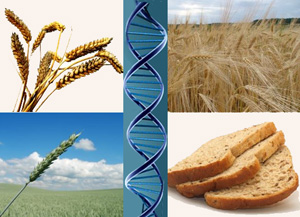
Stock images from sxc.hu |
Source:
iSGTW - International Science
Grid This Week
Providing vital food for
billions of people, wheat cannot afford a sick-day off. It must
resist new diseases, adapt to environmental change and flourish
in the face of viruses, bacteria, insects and fungi.
Cultivated since the dawn of
civilization, wheat must now enter the 21st century.
The race for survival
The keys to flourishing wheat fields are diverse and effective
genes, found in wheat’s gargantuan genetic toolbox: a DNA
collection containing an astounding 17 billion base pairs.
“If you can find the right
genes and the right alleles for a given genome, you can select
the qualities you want in a new wheat variety,” says Philippe
Leroy of
Génétique Diversité & Ecophysiologie des Céréales in
Clermont-Ferrand, France.
“You don’t cultivate the same
type of wheat in the North of Europe as the South of Europe or
as in China,” Leroy explains. “Each area has its own strains,
its own diseases and climate, and therefore each needs its own
wheat varieties.”
Hunting for the right stuff
To streamline the gene
selection process, Leroy and his colleagues, Matthieu Reichstadt
and Franck Giacomoni, are developing a system that automates the
hunt for new genes in the wheat genome.
Called the
TriAnnotPipeline, the project is part of the
International Wheat Genome Sequencing Consortium, which aims
to accelerate the creation of new wheat varieties.
These new varieties can be engineered to be more resilient to
environmental change or better suited to other uses, such as
bio-fuel, Leroy says.
After sequencing, the TriAnnotPipeline automatically searches
databases for genes common to other crops, and also notes
sequences that look like new genes. Researchers can then isolate
these areas of interest for further study.
A lengthy process, Leroy admits, but worth it to help ensure our
grandchildren can enjoy their bread and pasta as much as we do.
The TriAnnotPipeline project began in 2002 and is available
on several computing platforms, including the
AuverGrid,
in Clermont-Ferrand, France. Since 2006 the TriAnnotPipeline has
been supported by a European grant called
LifeGrid,
coordinated by the Conseil Regional d’Auvergne in France.
TriAnnotPipeline recently
presented at the
EGEE
User Forum in France.
Danielle Venton, EGEE |
|
