Newark, Delaware
September 10, 2007
|
 |
|
Blake
Meyers, associate professor of plant and soil sciences
at UD, is leading a $5.3-million research project to
advance scientific understanding of the rice
epigenome--the series of biochemical modifications of
the rice DNA that can toggle a gene on or off. Photo by
Kathy F. Atkinson |
Using a novel “deep sequencing”
technology that can in one fell swoop decode 50 million
sequences representing well over a billion bases of DNA, a
research team led by University of
Delaware scientists is working to unmask where, why and how
certain genes are switched on or off in rice--a crop vital to
the world's food supply.
The goal of the four-year project, which is supported by a
$5.3-million grant from the National Science Foundation (NSF),
is to advance scientific understanding of the rice
epigenome--the series of biochemical modifications of the rice
DNA that can toggle a gene on or, conversely, silence it.
Ultimately, the research may lead to the development of hardier
strains of rice, as well as shed light on similar mechanisms at
work in corn and other important cereal grains that are closely
related to rice.
Blake Meyers, associate professor of plant and soil sciences at
UD, is the principal investigator on the project, which also
involves Guo-Liang Wang, a rice biologist from Ohio State
University; Steven Jacobsen, an expert in epigenetics, and
computer scientist Matteo Pellegrini, both from the University
of California at Los Angeles; and Yulin Jia, a plant pathologist
at the U.S. Department of Agriculture's Dale Bumpers National
Rice Research Center in Stuttgart, Ark.
The effort builds on Meyers' previous awards from the NSF Plant
Genome Research Program, as well as ongoing investigations of
small RNAs--short lengths of ribonucleic acids that act as gene
regulators--performed in collaboration with Pamela Green, the
Crawford H. Greenewalt Endowed Chair in Plant Molecular Biology
at UD, whose lab is next door to Meyers' in the Delaware
Biotechnology Institute. These projects have now propelled the
research in a new direction, to new frontiers in the field of
epigenetics.
“Epigenetics refers to a heritable change that is not a result
of a change in DNA sequence, but rather a chemical modification
of nucleotides in the DNA or its associated proteins,” Meyers
said. “That means that these changes can be reversible, and it's
easier to switch them on or off. Small RNAs are one of the key
'control switches,' directing these modifications,” Meyers
noted.
State-of-the-art sequencing by synthesis (SBS) technology
developed by Solexa Inc., in Hayward, Calif., will provide the
data essential to the project. This novel “deep sequencing”
tool, which can decode tens of millions of sequences during a
single run, has become available over the last year. The
application of SBS to epigenetics research was demonstrated in
the human genome only within the past few months. The UD-led
effort will be one of the first large-scale projects to use this
approach in crop plants.
“If you think of a gene as part of a set of chromosomes, a gene
is just a small fraction of a percent of a complete genome,”
Meyers said. “If we learn about that gene by random sampling, by
using 50 million total sequences, which is what SBS provides, we
can characterize that gene at depth,” he noted. “Using this
method, we can obtain statistically robust data for nearly all
genomic regions in a single experiment.”
The scientists will use the technology to look for chemical
modifications in chromatin, the building-block material of
chromosomes, consisting of DNA and the proteins that interact
with it. The scientists want to know how the chromatin is
configured and what role changes in the material play in plant
development.
“Formerly, we had a very narrow picture of a plant's genome;
with these new sequencing technologies, we now have the
opportunity to acquire a comprehensive picture at fine detail,”
Meyers said. “It's like looking through a high-powered
telescope--but now we have a wide-angle lens on that telescope
to take in a view with both breadth and depth.”
|
 |
|
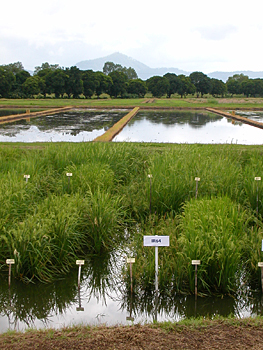
This
photo of rice was taken by Blake Meyers during a visit
to the International Rice Research Institute in the
Philippines in 2005. The trip, which resulted in a new
collaboration on small RNAs, was funded by an
International Research Award from UD's Center for
International Studies. |
Besides studying the state of the
genome using a variety of different strains of rice plants, the
research team will develop new bioinformatics methods to process
the vast amounts of data and mine new discoveries.
“The project is part biology and part technology,” Meyers said.
“Developing the bioinformatics to handle the data is critical.
You have to know what to do with it. As our bioinformatics
capabilities have grown, so have the resources available to the
public through our web sites,” he noted. “And these online
resources have led to important new collaborations.”
The data from the current project will be accessible through web
sites at UD and UCLA--[http://mpss.udel.edu/rice]
and [http://epigenomics.mcdb.ucla.edu].
The research project also includes an innovative education and
outreach component targeting graduate students in plant science.
Students will write, submit and exchange research proposals with
students from different universities. They will then serve on a
panel to critique and rank the proposals, modeled after the
National Science Foundation's own proposal review process.
“Since planning experiments and justifying these through writing
proposals is such an integral part of what a scientist does, I
thought this would be a good experience for our students,”
Meyers said. “This way, they can also see what their advisers go
through,” he added, grinning.
Meyers developed the educational project several years ago in
the advanced plant genetics course (PL636) he teaches in the UD
College of Agriculture and Natural Resources. Since then,
several colleagues and their classes at Iowa State and Penn
State have participated in the program, exchanging proposals
with UD, and UCLA and Ohio State are planning to join the
program during the current four-year grant.
“My hope is that this program and its proposal exchange system
can be used broadly by plant genetics and genomics courses at
universities to build writing, communication and critical
thinking skills among graduate students,” Meyers said.
Article by Tracey Bryant |
|
