Chevy Chase, Maryland
March 8, 2007
 |
|
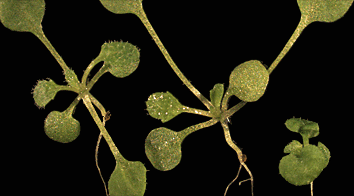
A photograph
of Arabidopsis shoots. On the left is a
wild-type plant (normal), on the right is a
brassinosteroid receptor mutant (bri1) and in
the middle is a bri1 mutant plant in which the
receptor has been expressed only in the L1 layer
(the epidermis).
Photo: Laboratory of Joanne Chory |
|
A secret long held by plants has
been revealed by Howard Hughes
Medical Institute researchers. The new discovery, which
builds on more than a decade of painstaking surveillance of
cellular communication between different types of plant tissues,
shows clearly for the first time how plants “decide” to grow.
The research, conducted by Sigal Savaldi-Goldstein and Howard
Hughes Medical Institute investigator Joanne Chory at The Salk
Institute for Biological Studies, puts to rest a century-old
debate over which tissue system in plants drives and restricts
cell growth.
“Our work exposes the presence of
cell-cell communication during growth, from the epidermis to the
inner layers. Such a mode of communication is important for
plants to maintain a coherent and coordinated growth of the
shoot,” said Savaldi-Goldstein, a postdoctoral fellow in Chory's
lab.
Chory's research group is interested in identifying the
mechanisms by which plants alter their shape and size in
response to changes in their environment. Chory studies
Arabidopsis, a member of the mustard family that is to plant
biologists what the mouse is to mammalian geneticists.
“How do organisms decide when to grow and when to stop growing?
These questions are especially important in plants because they
are rooted in the ground and must alter their shape and size in
response to their local environment. Thus, it's a question of
survival,” added Chory. “It took us 10 years to develop the
tools to ask the question. It is very satisfying for me to see
the results.”
Roots and shoots are a plant's two major organ systems. For this
study, published in the March 8, 2007, issue of the journal
Nature, the scientists examined shoots and the three layers of
tissues that make up the shoot system: the epidermis, which is
the waxy, protective skin; the mesophyl tissue, which contains
the plant's chloroplasts—cells that conduct photosynthesis; and
the vascular tissue through which water and nutrients are
transported.
During the last decade, Chory has made a number of significant
discoveries involving a key family of plant hormones called
brassinosteroids, as well as the receptors for the hormones and
the genetic factors that regulate production and uptake of the
hormone in the different layers of plant tissues. According to
Chory, brassinolide is a potent growth hormone involved in the
plant's response to light. Such responses, which include
adjusting plant growth to reach light or strengthening stems to
support leaves, are central to plant survival. Brassinosteroid
biosynthesis has become a critically important area of plant
biology research with significant implications for commercial
agriculture.
“It's been a matter of some debate for a very long time if one
of these tissue layers controls plant growth or if all three
layers have to work together,” Chory said. “Our paper shows very
clearly that the epidermis is in control—in both driving and
restricting growth. In addition, our studies show that the cells
in the epidermis “talk” to the cells in the inner layers,
communicating that they too should expand.”
Savaldi-Goldstein made the discovery that the signal for growth
originates in the epidermis by experimenting with dwarf
Arabidopsis plants and the expression of brassinosteroids in the
outer and inner layers of the shoot. When brassinosteroid
hormone was expressed and taken up by receptors in the
epidermis, dwarf plants grew to their full size.
Savaldi-Goldstein and Chory also found that when a gene is
expressed in the epidermis that inactivates brassinosteroid, the
plant restricts growth. Thus, cell signaling began in the
epidermis and followed into the inner layers of tissue,
directing those cells to grow or to restrict growth.
The outer epidermis, which helps plants retain water and
regulate the exchange of gases, clearly plays the role of
environmental sentinel, communicating to plant tissues when
conditions are right to seize the day for growth or hold back
under less opportune conditions. More study is needed to
determine all of the cues that spark the intimate dialogue
between the cells of the epidermis and the inner cells of the
shoot.
“Our study says that the major target tissue in the shoot for
steroid hormones is the epidermis. Our results also show that
these hormones act locally. As similar studies are done for
other plant hormones and in other organs, such as the root, we
will know the major sites of action of each plant hormone and
will be able to make models to predict how they work together to
give rise to the tremendous diversity of shape and form found in
the flowering plants,” said Chory.
For the moment, the research is an important addition to the
fundamental knowledge of plant growth and survival. But the
research and the work to follow have much broader implications.
“If we want to feed over nine billion people by the year 2050,
then understanding the basic mechanics of plant growth is
required,” said Chory. “This knowledge will ultimately lead to
our ability to increase yield, while decreasing the need for
fertilizer and pesticides.” |
|
