Kutztown, Pennsylvania
July 13, 2006
Source:
The New Farm
Farmer-to-Farmer Know-How from
The Rodale Institute
By Paul Hepperly, PhD
Research & Training Manager
The Rodale Institute
ASR
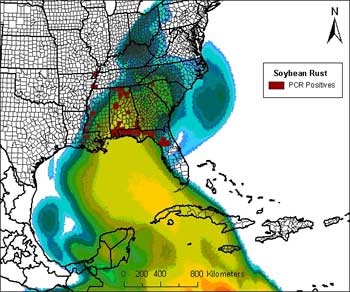
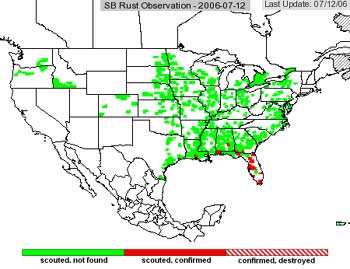
confined so far to Deep South where its kudzu host gives winter
lodging. The
ancient Romans prayed to Rosbigus, the god of rust who could
protect their crops from (to them) mysterious diseases in
harvested wheat and in stored bread during winter months.
Ceremonies were given to allay this deity so the cereal
crops—needed for the daily sustenance of Rome—were productive
and safe to eat.
Today, the huge multi-billion
dollar United States soybean crop is threatened by Asiatic
Soybean Rust (ASR), a fungal disease caused by Phakopsora
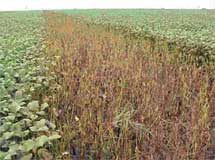
pachirhizi. This pathogen can eliminate up to 90 percent of
soybean yield under severe epidemic environments. While
varieties vary in their tolerance, no commercial strain has
resistance to this rust.
The ASR fungus originally
wrought havoc in Asia and Africa, hitting more recently Brazil
and the United States. Hurricane Ivan is attributed with
bringing ASR spores to Florida from South America or Africa in
the fall of 2004. By the end of 2004, soybean rust was
identified in about eight counties, mostly in the panhandle of
northwestern Florida. By the fall of 2005, the same rust was
identified in about 10 states and in 138 counties.
As important as soybeans are to
the US ag economy in terms of quantity—hence, the threat of a
catastrophic disease exposure—they are prominent in organic
production due to their distinctive quality. Because of consumer
concerns about Roundup Ready genetically modified soybeans in
food products, there has been increasing demand for organic
soybeans over the last decade. Because there has been no
confirmed defense against ASR that was permissible under the
rules of the USDA’s National Organic Program, the viability of
organic beans seemed to be in danger, especially in the southern
states.
Better news
in 2006
But wait. If you are an organic
soybean farmer it’s way too early to give up on the crop, given
differences developing this season. By early July, the number of
counties with soybean rust was only up to 24, all of them in the
Deep South relatively close to the Gulf of Mexico. Soybean rust,
like soybeans, will overwinter only in southern Florida and
Texas. The overwintering host has been shown to be kudzu (Pueraria
spp.), the notorious runaway forage vine that cascades over
trees in the Southern summer but only survives unfrozen on live
leaves at the most southerly points of the continental US.
More good news: AgraQuest, a
venture capital group developing biocontrol organisms for
disease and pest management, has registered the first
organically approved biocontrol specifically formulated for
rust. In 2005, results both within and outside the United States
shows Ballad biocontrol fungicide significantly improves both
yield and protects against many non-rust diseases to boot.
Bacillus pumilus (BP)
is a patented biocontrol bacteria in the same genus as
Bacillus thuringiensis (BT). Many organic farmers are well
aware of BT for its ability to control caterpillar pests. These
bacteria produce a resistant endospore, which allows a
biological agent to survive commercial storage and distribution
without decreasing insect or disease control in BT or BP,
respectively.
In addition to direct action to
kill rust, B. pumilus works by activating the soybean
plant defense system as well as both blocking leaf-to-rust-spore
contact and through the action of potent amino sugar antifungal
antibiotics. This last action is expressed by inhibiting fungal
cross-wall formation, new cell development, and destroying
membranes, which leads to pathogen cell death. In addition, the
soybean rust action has been demonstrated on septoria brown
spot, frogeye leafspot (Cercospora sojina), soybean
powdery mildew (Microsphaera diffusa) and purple leaf
blight and seed stain (Cercospora kikuchii).
Controls pay
for organic beans
But does the application pay?
Average yield increases from two to four applications is 17
percent. This would cost about $20 to $40 approximately per acre
for a seven-bushel bump on 45 bu/ac beans. Whereas for
conventional beans this might have a value of about $40 an
acre—being near a wash—in the case of $10 organic beans, this
would be a value of at least $70 dollars per acre on the same
yield potential. Wholesale prices reported from seven terminal
markets as July 11 ranged from $9.50 to $14.50 per bushel for
certified organic soybeans, according to
The New Farm
Organic Price Index.
Ballad fungicide is used at two
quarts per acre and applied at 14-day intervals starting at or
slightly before or after start of flowering at the R1 stage. For
growth stage details, visit:
www.ext.nodak.edu/extpubs/plantsci/rowcrops/a1174/a1174w.htm.
Trials in South Africa
concluding in March 2005 showed Ballad applications of two
quarts per acre gave 95 percent control of soybean rust—not
statistically more significant than the synthetic chemical
control azoxystrobin. There were also two trials in 2005 in
Argentina. In the first trial, yield was increased five bushels
per acre with a 10-percent decrease in soybean rust. In the
second, one application at the R5 stage (just before full
green-bean stage) reduced rust by 96 percent and bumped yield by
17 bushels—two bushels per acre more than the mixture of
synthetic fungicides tested.
We are collaborating with Iowa
State University, University of Florida and Michigan State
University to examine ASR controls for organic farmers. Our
Florida collaborators tested Ballad with three applications at
R1 that showed rust decreased about two-thirds.
Dr. Boyd Padgett of Louisiana
State University showed Ballad bumped the yield by seven bushels
per acre—almost 50 percent over non-treated by controlling
Cercospora Leafspot in the absence of rust in 2005.
We plan to look at Ballad
closely in Pennsylvania this year and, although we do not expect
soybean rust, we will see how it (in addition to lime sulfur and
soybean oil treatments) does on other diseases and get our feet
wet on the product. Soybean rust was reported as far north as
North Carolina and Missouri last year, so you may want to be
particularly careful this year scouting your fields,
particularly below the Mason-Dixon line.
I don’t know if praying to the
rust god will work for you, but being prepared with information
on ASR and its management will definitely help put you ahead in
the rust game.
|