Basel, Switzerland
July 29, 2004
• Sales up
12 percent to $4.6 billion, +6% CER(1)
• EBITDA(2) up 17 percent to $1367 million, +13% CER
• Earnings per share(3) up 49 percent to $7.70
• Free cash flow(4) $676 million
Financial
highlights (unaudited)

(1) For a definition of
constant exchange rates, see Appendix A.
(2) EBITDA before restructuring and impairment is a non-GAAP
measure in regular use as a measure of operating performance,
see Appendix D.
(3) EPS on a fully-diluted basis before restructuring and
impairment, see Note 4, and before a one-off tax credit
associated with the crystallization of previously unrecognized
tax losses.
(4) For a definition of free cash flow, see Appendix C.
(5) The amounts including restructuring and impairment are
reported in accordance with International Financial Reporting
Standards (IFRS). The impact of restructuring and impairment in
2004 is $172m (2003: $59m) on net income and $1.61 (2003: $0.58)
on earnings per share.
Michael Pragnell, Chief
Executive Officer, said:
“In the first half of 2004 the strength of our business and
market leading products has enabled us to take full advantage of
a recovery in agricultural markets. This has resulted in robust
sales growth across both Crop Protection and Seeds. Professional
Products and our consumer-driven Seeds businesses, Vegetables
and Flowers, have again registered significant growth. With the
recently announced acquisitions in Seeds we have reinforced our
position in US corn and soybean. Improved product mix driven by
higher sales of new products coupled with the further
streamlining of the cost base has led to a significant
improvement in profit; combined with a lower tax rate, this has
contributed to strong growth in earnings per share.”
Highlights for
first half 2004
Sales at constant exchange
rates (CER) increased by six percent. Crop Protection sales were
six percent higher; excluding the impact of range
rationalization they were seven percent higher. Seeds sales rose
by eight percent.
EBITDA improved by 13 percent (CER) benefiting from the growth
in sales and an improved product mix.
Earnings per share,
excluding restructuring and impairment, were $9.05. Excluding a
one-off tax benefit earnings per share were up 49 percent to
$7.70; after charges for restructuring and impairment earnings
per share were $6.09 (2003: $4.60). In addition to the
improvement in operating income, the increase reflects lower net
financial expense as well as a lower underlying tax rate.
Currency: Sales were
positively impacted by six percent due to the weakness of the US
dollar, notably against the Euro. At the EBITDA level this
positive impact was partly offset by the strength of the Swiss
franc and sterling, which increased costs reported in dollars.
Crop Protection: Sales
increased across all regions benefiting, in particular, from
continuing buoyancy in Latin America and strong demand in
Europe. Increased disease pressure in both regions contributed
to a significant increase in fungicide sales. The further
roll-out of new products and technologies drove double-digit
growth in Insecticides. Professional Products continued its
record of top line growth driven by the expansion of seed
treatment. Total sales of new products grew by $107 million
(CER) to reach $465 million reflecting, in particular, the
continuing success of the CALLISTO range ($235 million, CER)
and of ACTARA/CRUISER ($153 million, CER). The range
rationalization program, to be completed in 2004, reduced sales
by $32 million (CER); the cumulative impact of this program to
date is $288 million (CER). Sales growth combined with improving
product mix resulted in an increase in gross margin to 54.7
percent (2003: 53.4 percent). EBITDA rose by 14 percent (CER) to
$1246 million.
Seeds: Sales increased
across all businesses: Field Crops, Vegetables and Flowers.
EBITDA increased by five percent to $206 million reflecting the
expansion of higher margin businesses and higher prices,
partially offset by increased expenditure associated with new
growth opportunities. The Field Crops business in North America
will be significantly strengthened through four acquisitions
announced in the first half of 2004. These comprise corn
breeding material acquired from CHS Research; the Garst corn and
soybean business acquired from Advanta; the
Golden Harvest group of companies; and GA21 herbicide tolerant
technology. At completion, which is expected in the third
quarter, the Garst and Golden Harvest acquisitions will increase
Syngenta’s US market share in corn from six percent to 15
percent and in soybean from five percent to 13 percent,
providing an enhanced platform for the launch of a complete
range of biotech traits in corn from 2005.
Plant Science: The range of
traits currently under development includes traits to control
insect pests which reduce yield in corn and cotton as well as
the ingress of GA21 herbicide tolerance in corn germplasm. The
recently announced Seeds acquisitions offer significant
potential for leveraging these traits in corn. In enzymes,
QUANTUMTM microbial phytase has made its first sales in Mexico
and is awaiting US registration.
Operational efficiency:
Total restructuring and impairment charges during the period
were $264 million (cash: $144m; non-cash: $120m) of which the
majority related to the program to streamline global operations,
announced in February. The total cost of the program is expected
to be around $850 million over five years including a non-cash
charge of $350 million, with peak savings of $300 million
expected by 2008. Cumulative savings from the merger synergy
program, now completed, amount to $646 million.
Cash flow and balance sheet:
Free cash flow of $676 million (2003: $695 million) reflected
the increase in EBITDA and the reduction in net financial
expense. This strong cash generation was achieved after a $455
million increase in trade working capital, largely accounts
receivable, associated with higher sales. Tight inventory
management ensured that the ratio of trade working capital as a
percentage of sales at period end was maintained at 44 percent.
Fixed capital expenditure of $70 million was below depreciation
of $130 million.
At period end net debt was $590
million (2003: $1063 million) representing a gearing ratio of 11
percent (2003: 22 percent). In the second half, gearing is
expected to increase due to the cash outflow associated with the
acquisitions announced during the second quarter.
Cash return to shareholders:
On 27 April 2004 the Annual General Meeting approved a doubling
of the dividend for 2003 to CHF 1.70 per share which was paid on
16 July. In May the company commenced a share repurchase
program; by 30 June 866,326 shares had been repurchased at an
average price of CHF 101.5 which equates to $68 million.
Taxation: The underlying
tax rate for the first half was 25 percent (2003: 37 percent).
This significant reduction was due to the earlier-than-expected
completion of the tax structure optimization. The ongoing tax
rate is expected to remain in the mid-twenties for the
foreseeable future. The reported tax rate for the first half was
12 percent. This reduction of 13 percentage points was due to a
one-off credit associated with the crystallization of previously
unrecognized tax losses. This one-off credit results in an
expected cash benefit of $120 million to be spread over three
years.
Outlook
Michael Pragnell, Chief Executive Officer, said:
“As we take advantage of all opportunities in a more stable
agricultural environment notably in Europe, and of continued
expansion in Latin America, we expect growth in earnings per
share* for the full year 2004 to be broadly in line with that
achieved in the first half. We have made good progress in
implementing our strategy and this is reflected in top-line
growth; we look forward to completing the acquisitions of Garst
and Golden Harvest during the third quarter and creating an
integrated US corn and soybean business in this important
market. Building on our expected strong performance in 2004 we
remain committed to our target of annual growth in earnings per
share* in the high teens in 2005 and 2006. Furthermore, as
announced earlier this year, we plan to return more than $800
million to shareholders over the next three years through the
combination of a progressive dividend policy and share
repurchase program.”
* Fully diluted, before
restructuring and impairment and one-off tax credit.
Crop Protection
Except where stated, all narrative in this section refers to the
half year. For a definition of constant exchanges rates and of
range rationalization, see Appendix A and Appendix B
respectively.
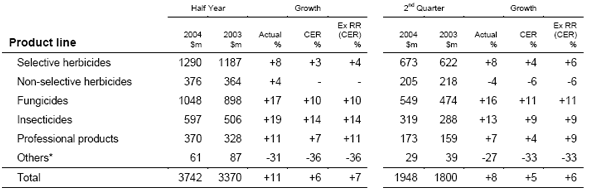
* Includes industrial sales of intermediates largely in Europe.
Selective Herbicides: major
brands BICEP® MAGNUM, CALLISTO®/LUMAX®, DUAL® MAGNUM, ENVOKE®,
FUSILADE®MAX, TOPIK®
Sales of selective herbicides were
driven by CALLISTO®, which confirmed its post-emergence
leadership in US corn and expanded in European markets. The
combination product LUMAX® gained share in pre-emergent control
in US corn, to an extent replacing sales of DUAL®/BICEP® MAGNUM.
ENVOKE® was successfully launched on cotton and sugar cane in
the USA and Brazil. TOPIK® registered strong growth in Europe
and Asia more than offsetting lower sales in Canada.
Non-selective Herbicides:
major brands GRAMOXONE®, TOUCHDOWN®
GRAMOXONE® sales increased in all regions; the main driver was
China following planned channel inventory reduction in 2003. A
decline in TOUCHDOWN® reflected marked price reductions in the
US glyphosate market. Sales of TOUCHDOWN® grew in Latin America
and in Europe.
Fungicides: major brands
ACANTO®, AMISTAR®, BRAVO®, RIDOMIL GOLD®, SCORE®, TILT®, UNIX®
Fungicides registered strong growth across all regions. AMISTAR®
registered double digit growth driven by: higher disease
pressure in Europe, notably France; treatment of soybean rust in
Brazil; and increased demand on soybean and rice in the USA.
RIDOMIL GOLD® also grew sales in all regions.
Insecticides: major brands
ACTARA®, FORCE®, KARATE®, PROCLAIM®, VERTIMEC®
ACTARA® continued its broad-based increase in market
penetration. Sales doubled in Brazil and grew strongly in the
USA and Japan, where a new combination product was launched on
rice. KARATE® also registered broad-based growth following the
withdrawal of organophosphates in several markets. VERTIMEC®
grew in the USA due to increased pest pressure. Sales of FORCE®
were lower compared with a particularly strong first half in
2003.
Professional Products:
major brands CRUISER®, DIVIDEND®, HERITAGE®, ICON®, MAXIM®
The main driver was Seed Treatment with the continuing success
of CRUISER® and MAXIM®. In addition, the roll-out of
insecticide/fungicide combinations offers growers complete early
protection, leading to higher yield. Turf sales improved with
better weather conditions in the US golf market. Home and Garden
sales were impacted by the continuing phase-out of the
insecticide diazinon in the USA.

Growth in Europe, Africa and the Middle East reflected
more normal weather conditions than in 2003. In France sales
growth was particularly strong, benefiting from the closer
alignment of sales with consumption. Demand in Central and
Eastern Europe increased strongly as the Company’s presence in
the region expanded. Excluding industrial sales Europe, Africa
and the Middle East showed CER growth of seven percent.
In NAFTA, US sales improved
in the second quarter with strong growth in new products and
AMISTAR® more than offsetting further price decline in
glyphosate. Strong growth continued in Canada and Mexico.
Latin America: Sales
expanded across the portfolio in Brazil and Argentina as the
organization capitalized on buoyant conditions, its broad
product offer and marketing strength. Soybean and cotton acreage
in Brazil increased significantly and sales of fungicides grew
strongly with the spread of soybean rust.
In Asia Pacific sales grew
in Japan and India, and in China where sales of GRAMOXONE® have
recovered following channel de-stocking. These more than offset
lower sales in Thailand and Australia, the latter due to dry
weather conditions.
Seeds
Except where stated, all narrative
in this section refers to the half year. For a definition of
constant exchanges rates, see Appendix A.

Field Crops: major brands NK® corn, NK® oilseeds,
HILLESHÖG® sugar beet
Sales of NK® soybean grew strongly and NK® corn benefited from
increased demand for new offers incorporating seed treatment
solutions. Sunflowers registered strong growth in Eastern
Europe. HILLESHÖG® sugar beet sales improved with a notable
increase in Eastern Europe.
Sales of GM products accounted for 18 percent of total Seeds
sales and for three percent of total group sales.

Vegetables and Flowers: major brands S&G® vegetables,
ROGERS® vegetables, S&G® flowers
Sales of vegetables grew in all regions and continued to benefit
from strong consumer demand for fresh produce. Sales of
DULCINEATM products in the USA progressed particularly well with
the successful launch of a cantaloupe melon and continued growth
of PUREHEART™ seedless watermelons.
Sales of S&G® flowers increased reflecting the rapid
introduction of new varieties and effective supply chain
management.
Sales in Europe, Africa and the Middle East grew strongly
in oilseeds, vegetables and flowers. Demand for Field Crops, in
particular sunflower and sugarbeet, continues to grow in Central
and Eastern Europe.
NAFTA performance was
driven by strong demand for corn and soybean and the ongoing
expansion of DULCINEA™, now fully consolidated.
Low season sales in Latin
America benefited from an increase in corn sales in
Argentina and some smaller Latin American countries.
In Asia Pacific all product
lines increased sales. Corn continued to perform well in India
and the Philippines. In Japan the consolidation of Dia-Engei,
acquired in February, contributed to an increase in Flower
sales.
Syngenta is a
world-leading agribusiness committed to sustainable agriculture
through innovative research and technology. The company is a
leader in crop protection, and ranks third in the highvalue
commercial seeds market. Sales in 2003 were approximately $6.6
billion. Syngenta employs some 19,000 people in over 90
countries. Syngenta is listed on the Swiss stock exchange (SYNN)
and in New York (SYT). |


