|
September 3, 2003
continued from
page 3
The Crop
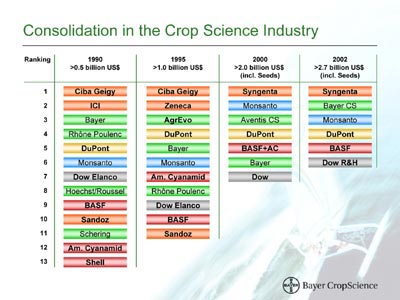
Science industry has been undergoing a massive, worldwide
consolidation process in the last 15 years. In 1990, 13 firms
with global research and development activities were still
operating in this field - among them well known players such as
Shell, American Cyanamid, Sandoz, Ciba, Hoechst, Schering, ICI
and Rhone Poulenc. Today, just six companies represent a
combined market share of over 80 %.
The major drivers of this global consolidation process have been
a very competitive market with limited growth perspectives,
constantly growing regulatory requirements and the substantial
R&D investment necessary to maintain a competitive platform for
innovation.
Bayer, in
the past, did not participate in this consolidation and
consequently fell behind in the ranking of global companies. By
acquiring Aventis CropScience, we regained our position among
the leaders of our industry, fulfilling one of Bayer's key
strategic objectives.

The
demands of a growing world population for food, feed and fiber
require world agriculture to produce higher yields from less
cultivated land. Improving the productivity of existing
agricultural systems without compromising long-term ecosystem
health presents a key global challenge, which must be met if we
want to ensure long term food security for all.
Sustainable Development requires a major contribution from
agriculture, as stipulated in the Rio Conference in 1992 and
reinvigorated at the World Summit in Johannesburg exactly a year
ago.
Responsibility for implementing Sustainable Agriculture must be
shared between different stakeholders. We are therefore
convinced that public-private partnerships as a framework for
multi-stakeholder approaches are the way forward to enhance
further progress, as no one has all the necessary information or
carries out all the labor.
At the same time, we need locally adapted approaches to
Sustainable Agriculture, as no single, ready made solutions for
all exist. The approaches must offer consumers the choice and
farmers the flexibility to employ the most suitable combination
of available tools and strategies to meet their needs within the
conditions in which they operate. Where appropriate, integrating
proven traditional methods with the use of innovative
technologies will lead to optimized agricultural productivity.
We at Bayer CropScience are firmly committed to promoting
Sustainable Agriculture that ensures an appropriate balance
between economic viability, environmental responsibility and
social acceptability. Our technology solutions help farmers
improve productivity to meet the food, feed and fiber needs of a
growing world population.
The implementation of Sustainable Agriculture is highly
dependent on a supportive socio-economic and political framework
that ensures access to the markets that value the quality of
agricultural produce.
>>>
page 5 |
